Friday, 30 January 2009

The strange case of the Florence Synagogue bomb - part three!

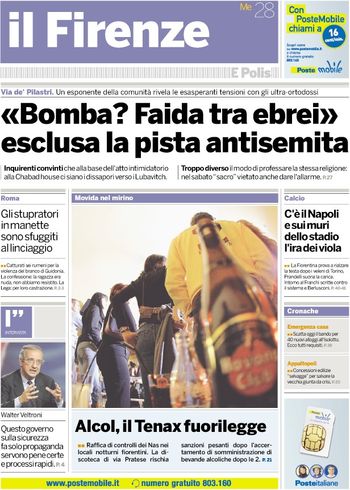
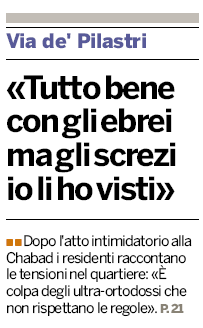
The strange story of the IED found near the Florence Synagogue has been covered once again by 'il Firenze' - a Florence newspaper. Today's issue is also here. 

Here's my translation. There is also a fragment from a Jewish Community press release about the other articles.

The [Florence Jewish] Community answers:

“Pay extreme attention. The political situation and the fragile state of things in  these months in Italy - we are referring to the minorities, the Jewish minority in particular was the target of several attacks -  command attention and circumspection from everybody’s part”. This is taken from a press release by the Florence Jewish Community.

Via de’ Pilastri. The neighbours talk about the strained state of things whence the act originated.

We live in harmony with the Jews, the real problem is that extremist…

The frictions with Borenstein reach their climax on Fridays, when he comes to cater for his followers.

By Claudio Bozza

These virulent quarrels have been going on for more than four years. They have also degenerated into a physical confrontation with the followers of the ultra-Orthodox Jew Eli Borenstein,  founder of the Chabad house in Via de’ Pilastri, where an ‘intimidation explosive device’ (unable to explode) was found on Jan the 17th. In the quarter, after ‘il Firenze’ reported on the groundlessness of the anti-Semitic motives, there is tension in the air.

This tension is not about conflicts with the citizens of Florence and the Jewish community: “On the contrary, we go along fine and there has never been a problem – says Lorenzo, the owner of a centuries old typography in via de’ Pilastri – the real problem is Borenstein, an extremist who’s causing trouble to everybody, especially to the Jews of his community, people he should see as his brothers”. Quarrels spark almost once a week, when Borenstein arrives from Bologna.

Besides the Chabad house he owns other premises in Via de’ Pilastri 28r. A relatively small space where, according to the neighbours, he manages to cater for up to 40 persons. They are new proselytes for his ultra-Orthodox Jewish denomination, they are the people clashing with the rest of the perfectly integrated Jewish Community.

“It’s hard to miss this gentleman: he arrives on Friday with his followers and he serves Saturday’s dinner and lunch in that little room – says a neighbour who however prefers to remain anonymous – they bring their food on the street and have no respect for decency”.

The infuriating thing for the neighbourhood is that all this is   done without the proper authorizations: in the past the Carabinieri and the NAS [the Italian police] intervened, and also the Finanzieri [the Italian IRS]. After that, no more checks and business as usual. Meals and entrance are absolutely free, but it’s only a trick to proselytize. At the end of the meals Borenstein asks for a contribution for the education of the youth of his community. And they are not small contributions, they say.

Thursday, 29 January 2009

The strange case of the Florence Synagogue Bomb - Part II


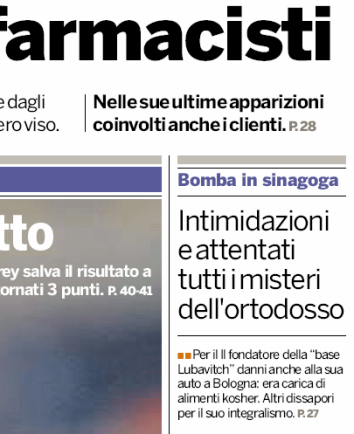
Here's another free translation of another article appeared today on "Il Firenze"  about the Jan 17th 2009 bomb finding near the Florence Synagogue - The Italian original (on page 27) is here

Business and mystery: two intimidation acts against the Chabad house were never claimed by anybody. 

The founder of the 'Lubavitch base' next to the synagogue is a Jewish restaurant owner:  first the bomb,  then his car’s glasses were shattered in Bologna. But everything looks like a quarrel between shop owners.

by C. Bozza - S. Brogioni 

"A very small environment",  they had told investigators. 
An environment restricted to a single street, where  the interests of shopkeepers are interwoven and sometimes clash.
What’s behind the ‘warning’,  executed materially with a camping gas canister, given to the owner of the Chabad house in Via de 'Pilastri? It’s not anti-Semitism, it’s business. 
The investigators, who have never talked about political or even racial motives,  but about a  "demonstrative gesture", privilege this hypothesis: intimidation against Eli Borenstein, a 60 years old Jew and  member of the ultra-Orthodox Lubavitch. A community in the community, coexisting not without disagreements because of the different ways of understanding and practicing Judaism. 
Within a few days, Borenstein received two “sgarbi” - "discourtesies” - never claimed by anybody: the bomb at the Chabad house and the shattering of his car’s glasses - a rented Renault Scenic - parked in front of his home in Bologna. 
Inside there was some food. Yes, because the business of this Jew living between Bologna and Florence  (where he goes only on Saturdays) is catering. 
Kosher food,  prepared according to the strict canons of Judaism:  in practice a restaurant for the Jews, especially American Jews, who,  thanks to the big network of Chabad houses in the USA and abroad, come to visit Florence and the nearby Synagogue in Via Farini. 
The Jan. 17th bomb  and the shattered glasses in Bologna are not the only effects of the disputes against Borenstein. 
Nearly 10 years ago, the Lubavitch boss, coming from Milan,  had rented a house in Via de' Banchi, behind Piazza Santa Maria Novella, where he made his headquarters in town. 
The arrival of the ultra-Orthodox sect shot a spark with their neighbors. Inside the apartment, besides praying and studying the Torah, Borenstein's followers gathered to celebrate in their own way, with dance and music that sometimes drove the neighborhood mad. 
Then the resulting quarrels forced Borenstein to leave the apartment.  The Lubavitch have a radical way of practicing Judaism.  On Saturdays, a holy day, among  thousands of prohibitions,  one must also not ring the doorbell. Because of this, at any time of day or night, anyone who wanted to enter the house would yell from the street. 
And the conflict with the neighbors inevitably became nerve-racking.

The strange case of the Synagogue bomb


This is my free translation of an article appeared on 'Il Firenze' a Florence newspaper on January the 28th. More on this soon.

The original (on page 27) is here

Via de Pilastri: Holocaust Remembrance Day: a member of the Jewish community rules out anti-Semitic motives.

“A bomb? Something between Jews” – investigations on personal feuds. 

The police are working on disputes between the ultra-orthodox Lubavitch, owners of the Chabad House hit Saturday, and the moderate Jews. Help was not called for immediately because of the Shabbat rule against telephoning. 

by C.Bozza – S. Brogioni firenze@ilfirenze.it 

“It’s no anti-Semitism, it’s all about personal feuds between the Florence Jewish community and the Lubavitch, a few ultra-orthodox Jews attending the Synagogue in Via Farini only sporadically.”

 An authoritative member of the 1000-person Florence Jewish community explains the motives behind the finding of a small camping gas bottle Saturday January the 17th  in front of the ‘Chabad House’ in via de’ Pilastri 48 (the place the Lubavitch have in every important city to host their followers). It is the Holocaust Remembrance Day and he wants to shed light on the episode. An anonymous source, whose words are nonetheless in agreement with the detectives working on the case about the bomb found during a Jewish sacred day. At first the sleuths had thought about an anti-Semitic act in relation with the bloody Israeli military operations in the Gaza Strip. The ‘bomb’ had a rudimental fuse, unable to let the gas explode. The hypothesis was plausible, almost obvious, but was soon abandoned to follow clues about a personal vendetta. A vendetta unleashed by somebody who had disputes with the ultra-orthodox Lubavitch. No one claimed to be the author of the action, something odd if there had been political motives.

The Florence Jewish environment is extremely fragile: two ways to think about and practice Judaism coexist. From one side almost all of the community, led by Joseph Levi, the rabbi of Synagogue in via Farini. From another side, the ‘Hassidim’, the most rigorous Jewish denomination: during the Shabbat they do not turn the lights on and they do not use the lift.

In 2000 Eli Borenstein, one of the most influential leaders of the Italian Lubavitch, bought an old shop to open the Chabad house (inside there is only some old stuff). The location is strategic to attract potential new ‘Hassidim’. Problems in the few yards between Via Farini and via de’ Pilastri soon arose. These Florence Jews are called ‘Lubavitch’ or ‘Lubavitcher’, a branch of Hassidism, borrowing their name and their ancient traditions from the old Russian town of Lubavitch, destroyed by the Nazis in 1941. Black coat, payot, and black hat: they come from all over the world to meet their leader Borenstein, who, however, lives in Bologna (where he received another ‘warning’) and goes to Florence only once a week (on Saturdays, that is) to host and cater for his followers. 

The Shabbat is a sacred day when it’s prescribed not to walk for long, not to prepare food, and not to do many other things. There is even a rule about not using the telephone: it’s because of this that, curiously, Borenstein warned the Police only after dark, when Shabbat was over, even if he had seen the ‘bomb’ already during the morning. “We hope to live together peacefully, but to see the Lubavitch proselytize with the Jewish American tourists in front of the Synagogue doesn’t seem to be very good for the community”: this was reported in the Florence edition of ‘La Repubblica’ soon after the arrival of the Lubavitch in town. A dislike that soon degenerated into a conflict between the two groups: this however is only the background of the intimidation act of Jan. the 17th. It could have been the result of personal motives.

This is the end of my translation. I recommend this comment from another blogger, too (in Italian)

UPDATE: I see that this little translation work has had a bit of exposure, and has been even reused somewhere else. It's all right by me,  reuse it as much as you like of course- though I have nothing to do with the websites where it has been copied.  It is significant news, it has not been denied, it has not been covered by the international press (but when the bomb looked like a terrorist act it was).  

Monday, 26 January 2009

Quem vult perdere, deus amentat.


Tempo fa mi è capitato di usare spesso questo adagio latino. Usare motti ricercati a volte può risultare lezioso, ma la tentazione è a volte (per me quasi sempre) irresistibile.  Spesso la storia di certe locuzioni è curiosa. Molte frasi usatissime ad esempio risalgono all’epoca moderna o al latino medioevale, non agli antichi romani (ovviamente si introducono comunque con 'i romani dicevano che...'). Ad una frase di Isaac Newton (if I have seen further it is only by standing on the shoulders of Giants) è stato addirittura dedicato un libro divertentissimo, ‘Sulle spalle dei giganti’ di Robert Merton.

Il detto ormai è presente un po’ in tutte le lingue. Copio da un paio di raccolte di proverbi.

Italiano: A chi Dio vuol castigare, leva il cervello o Quando Dio ci vuol punire, dal senno ci fa uscire.

Inglese :  When God wishes to destroy, he first deprives of reason. o Whom the Gods would destroy, they first make mad (noto anche per aver dato il titolo a un episodio di Star Trek)

Francese : Quand Dieu quelqu'un veut châtier, de bons sens le fait varier oppure Quand laDivinité prépare des malheurs à un homme lui enlève d’abord la raison.

Tedesco: Wenn strafen will die Gotteshand, so nimmt sie einem den Verstand (in tedesco suona bene quasi come in latino) 

Spagnolo: A pescedillo que se ha perder, alilas le han de nacer. oppure Da Dios alas à la hormiga, para que se pierda mas alna (curiosamente gli spagnoli virano al mondo animale)

In latino le varianti sono parecchie:

 Quem vult perdere, deus amentat.

 Quem Iuppiter vult perdere, prius dementat.

 Quem/quos  Deus perdere vult, dementat prius.

 Deus amentat quem prius vult perdere

 Stultum facit Fortuna, quem vult perdere

L’ultima frase in realtà ha una fonte precisa: si tratta di una massima di Publilio Siro, una delle tante in cui compare la Fortuna.

Siro però scriveva nel primo secolo. Molti dizionari di citazioni, o molti libri in cui la massima è posta come citazioni all’inizio di un capitolo o del libro stesso attribuiscono la paternità del detto ad Euripide, spesso riportando il testo in inglese o al massimo in latino.

Non sembra proprio che sia così, cercando con più attenzione. Alcuni testi danno come fonte Sofocle:

Οταν δ' ο δαιμων ανδρι πορσυνη κακα,
Τον νουν εξλαψε προτον ω βουλευεται 

Dovrebbe essere la riga 620 dell’Antigone, però andando a cercare il testo ci troviamo invece…

τὸ κακὸν δοκεῖν ποτ᾽ ἐσθλὸν
τῷδ᾽ ἔμμεν ὅτῳ φρένας
θεὸς ἄγει πρὸς ἄταν·
πράσσει δ᾽ ὀλίγιστον χρόνον ἐκτὸς ἄτας.

Mai fidarsi delle raccolte di citazioni. La prima frase pare che sia uno scolio del passaggio della tragedia di Sofocle (almeno così dice 'Notes and Queries’del 30 marzo 1850, trovata su Internet).

Sofocle stava parafrasando un poeta ancora più antico, sconosciuto. Una parafrasi simile si trova anche nell'orazione di Licurgo contro Leocrate. (cfr. http://en.wikiquote.org/wiki/Euripides#Misattributed )

L'autore della nostra citazione rimane dunque con ogni probabilità sconosciuto. Forse gli Dei (o Dio) ce lo hanno fatto perdere, non si sa se nella follia o meno.

Il detto non è nemmeno di origine biblica, come sostiene qualcuno. Anche se indubbiamente nel Vecchio Testamento ci sono passaggi simili. Questo ad esempio è Giobbe, 12:23-25

Rende grandi le nazioni e poi le distrugge, estende le nazioni e poi le porta in esilio.

Toglie il senno ai capi della terra e li fa vagare in solitudini senza strade.

Brancolano nelle tenebre senza luce, e li fa barcollare come ubriachi

Saturday, 24 January 2009

Thursday, 22 January 2009

X-Face in Thunderbird 2.0 - an easy recipe


This is my quick recipe and an annotation to myself to use and view X-face headers in Thunderbird 2.0 :

  1. Generate you text header using one of the many available venues, like this one.
  2. Install mnenhy as Thunderbird extension. mnheny will allow you to display X-Face icons in TB's message pane.
  3. To send Usenet posts with a X-Face icon do the following:
  • Open the Configuration Editor (Tools/Options/General - Configuration Editor). 
  • Locate your identity (or indenties) in the mail.identity.* configuration entries.
  •  Choose the id of the identity you want to associate with an xface (it's id1 id2 id3.. etc, lets say it's [ID]).
  •  Add a new string configuration entry named mail.identity.[ID].headers and assign to it the value xface .
  •  Add another new string named mail.identity.[ID].header.xface and paste the text header from 1. into the value. 
'xface' could be any other name of course. If you already have custom headers defined, you don't need this quick recipe. 
A plugin to choose multiple X-Face headers would be a cute idea, by the way.

Wednesday, 21 January 2009

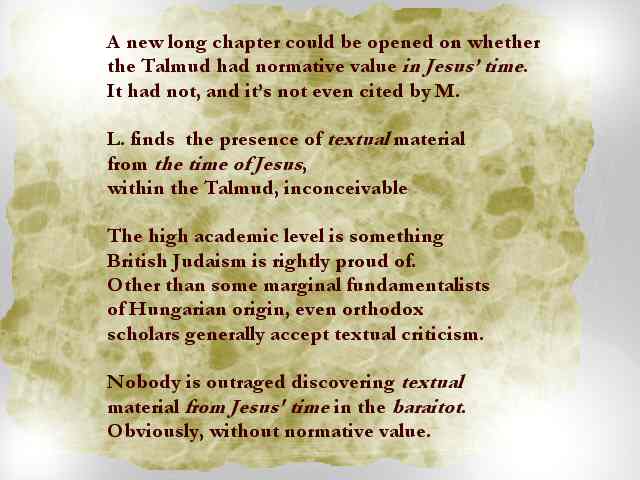
Talmudic Wisdom?

This post is not weirder than yesterday's post. It's on a whole new level of weirdness.
but also see this.